by Elena Roccaro
This contribution accompanies an ongoing research project on paper as a field of action, bringing publishing, graphic design and participatory art into dialogue with social issues and questions of dwelling. I am currently exploring how publishing formats and practices can have a social impact and engage people, both as approaches to inhabiting places and as community practices. The intention is to investigate how paper-based projects can bring people together and provide opportunities to experiment with a small-scale social infrastructure, in which roles, responsibilities and hierarchies can be explored and questioned. Through my PhD in Design for Social Change at ISIA Roma Design, I investigate how graphic design and publishing can contribute to social change by encouraging participation, the organisation of collective activities and the shared use of space.
This research began with 84/24 Venezia anarchica, my master’s thesis on the International Anarchist Gathering of September 1984 and the role of graphic design and publishing in shaping that experience. The thesis was developed at the Iuav University of Venice under the supervision of Professor Sara Marini, who teaches Urban and Architectural Composition, with the artist Antoni Muntadas as co-supervisor.
Lasting more than a year, the research combined studies of graphic design, anarchist literature and philosophy, interviews with publishers and experts, participants’ testimonies and consultation of the Giuseppe Pinelli Archive. The aim was to understand how anarchist ideas took shape in the Gathering’s organisational, cultural and design practices. In this self-organised, grassroots event, paper, graphic design and publishing helped coordinate activities and relationships between people, supporting the collective creation of spaces of autonomy and a different, if temporary, way of inhabiting Venice.
Alongside this historical reconstruction came the need to make a diverse and extensive body of documentation accessible, preserving its complexity and recognising the role of the Pinelli Archive. In October 2024, forty years after the Gathering, the project became an exhibition of archival materials hosted by the Iuav Tolentini Library, organised in collaboration with the Giuseppe Pinelli Archive in Milan and the Iuav Students’ Senate.
This process gave rise to a question that also guides my current research: how can graphic design, paper and publishing contribute to creating a collective space and encourage participation?
At Venice ’84, paper played a role before, during and after the event: in its preparation and organisation, and in connecting people across distances; during the Gathering, posters, leaflets, panels and publications brought people together, helped them navigate the venues and stimulated discussion; afterwards, books and magazines continued to explore its themes.
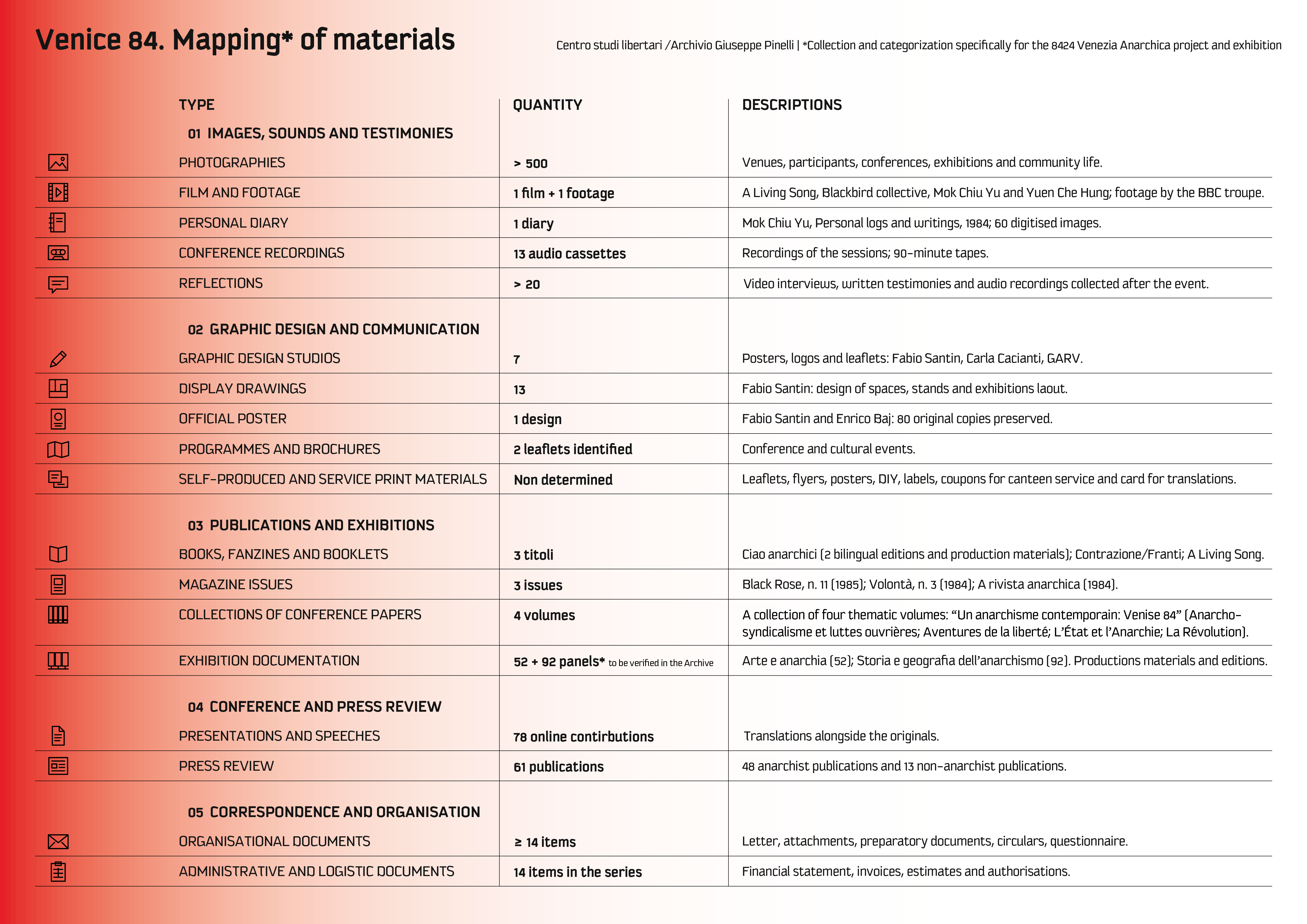
The Gathering took place across several locations in the city—Tolentini, Campo San Polo and Campo Santa Margherita—but the research revealed little memory of the event within the university, the city or among its residents. This limited public memory contrasted with a rich body of archival material, preserved and made accessible by the Pinelli Archive: over five hundred photographs, seventy-eight distinct contributions available online, a press collection covering sixty-one newspaper and magazine titles listed in the inventory, exhibition panels, correspondence, recordings, films and publications.
The 2024 exhibition brought these materials back into a public space in Venice, making them available to new audiences. The curatorial process involved reorganising the materials within a physical space according to their types, themes and connections, creating new juxtapositions and possibilities for interpretation.
The exhibition was accompanied by a programme of events involving some of the people who had helped make Venice ’84 happen. At an event hosted by the About association in Venice, Giorgio Canali, Marco Pandin and Kina’s singer revisited the musical dimension of the concerts in Campo Santa Margherita. The testimony of Elis Fraccaro, a member of the Nestor Machno group in Marghera, offered insights into the local organisational work and the role of the Utopia Due bookshop, where he worked alongside his partner Elettra Sivori and Piero Romano. The screening of A Living Song, by Blackbird, an anarcho-punk music collective from Hong Kong, added a distinctive cinematic perspective on the Gathering, also highlighting its international dimension.
The contributions of Rossella Di Leo and Roberto Viganò of the Giuseppe Pinelli Archive were essential, as were the graphic and editorial materials made available by Fabio Santin, who had been responsible for much of the visual communication and exhibition design in 1984.
The title 8424 referred to this return: documents preserved for forty years encountering people and places once again through exhibition, storytelling and discussion.
From 24 to 30 September 1984, Venice hosted the International Anarchist Gathering: over four thousand people from more than thirty countries gathered to discuss the potential of anarchism for social transformation.
Following the wave of protests in the 1960s and 1970s, the Gathering sought to connect different experiences, navigate the movement’s diversity and rethink its role in contemporary society.
The programme comprised four days of conferences, two main exhibitions, concerts, theatre, film screenings, publications and self-produced works, alongside assemblies and social gatherings. The activities took place mainly in the Tolentini district – in origin the Faculty of Architecture – as well as in Campo San Polo and Campo Santa Margherita. For a week, therefore, research, cultural and scientific production, and everyday life intertwined within the city’s spaces.
The Gathering was organised by the Centro Studi Libertari in Milan, the CIRA in Geneva-Lausanne and the Anarchos Institute in Montréal. Anarchist groups from Venice, Mestre, Marghera and Dolo, together with the Utopia Due bookshop, contributed to the preparation and running of the event.
The choice of Venice was based on relationships forged in previous years. The city had already hosted the 1976 Conference on Bakunin – the year the Centro Studi Libertari and the Pinelli Archive were founded – and, at the Tolentini, the 1978 conference on ‘The New Masters’ and the 1979 conference on ‘Self-Management’.
These events had fostered exchanges with the academic community. Figures such as Carlo Doglio, Giancarlo De Carlo, Riccardo Mariani and Franco Bunčuga had contributed, in different roles and through different paths, to linking libertarian thought, urban planning and reflections on housing.
In 1984, the Faculty of Architecture made its premises available without being directly involved in organising the Gathering. Late September offered favourable conditions: classes had not yet begun, and some of the summer cultural events were drawing to a close.
Venice’s labyrinthine layout also helped shape the experience. Walking between venues through the city’s narrow streets and squares created further opportunities for encounters along the way and brought participants into contact with residents’ everyday lives.
Organising the event nevertheless required ongoing negotiations with the municipal authorities. Bureaucratic difficulties and the unavailability of certain venues forced changes to the programme: some activities were relocated, while others, including a planned exhibition featuring works by the sculptor Alik Cavaliere and Enrico Baj, were cancelled.
From 26 to 29 September, Tolentini hosted the conference Authoritarian Tendencies and Libertarian Tensions in Contemporary Societies. At its busiest moments, more than twelve hundred people were present simultaneously in the lecture rooms and corridors.
The programme comprised eighteen sessions: five round tables, eleven seminars and discussion groups, and two plenary sessions. Simultaneous interpretation was provided in four languages. The Pinelli Archive’s digital collection now makes seventy-eight distinct contributions available.
Participants included Colin Ward, Murray Bookchin and Tomás Ibáñez, who also contributed to the opening of the 2024 exhibition. Marianne Enckell of CIRA, together with Amedeo Bertolo and Rossella Di Leo of Edizioni Antistato and the Centro studi libertari, played particularly important roles in organising the Gathering and developing its international networks.
The conference addressed power, work, self-management and revolution, connecting these themes with feminism, education, ecology and communication. It revealed an anarchism in dialogue with anti-patriarchal, peace and environmental movements, attentive to social transformation through everyday relationships and ways of living together. Conversations often continued beyond their allotted time, and when the university closed, some debates moved to other Gathering venues. The questions explored in the lecture rooms thus found practical expression in the organisation of meals, spontaneous assemblies and relationships with local residents.
Campo San Polo hosted a large circus tent for exhibitions, debates and screenings, also welcoming people who happened to come across the Gathering.
The two main exhibitions, which opened on 25 September, were History and Geography of Anarchism, curated by CIRA through an international network of collaborators and comprising 92 panels, and Art and Anarchy, produced by Studio A in Milan with Fabio Santin and other collaborators, comprising 52 panels. The first traced the movement’s places, events and key figures; the second, drawing on Pietro Ferrua’s research, explored the relationship between anarchist thought and artistic experimentation from the nineteenth century to the avant-garde movements. Accompanying talks by Arturo Schwarz, Benito Recchilongo and Laura Zelasnick broadened the discussion to the connections between art, alchemy, Tantrism, the press and anarchism, extending to contemporary graffiti in New York.
The tent also hosted films and documentaries about the Spanish Revolution, housing occupations, social struggles and anarchist migration. Some materials were brought directly by participants, extending the programme.
The installation nevertheless altered the square’s everyday uses. Some children felt deprived of their play space, prompting discussions between families and organisers, who acknowledged that they had not planned suitable activities for them. This episode illustrates how the temporary occupation of public space had to negotiate with those who already inhabited it.
Campo Santa Margherita was the Gathering’s social hub. Tables, chairs, kitchens and spaces for assemblies allowed people to spend time together, eat and talk throughout the day. The catering operation served hundreds of meals, coping with demand that exceeded expectations.
Luigi Veronelli, the well-known Italian food and wine writer and anarchist philosopher, contributed a selection of wines that also attracted many Venetians: sharing food and drink became an opportunity for contact between participants and residents.
The square also hosted artistic and theatrical interventions. The Black Rose Collective from Boston built a city from cardboard boxes coated in white plaster, covered with words, graffiti and drawings. The Alchemical Theatre replaced the Living Theatre, which was unable to attend because of Julian Beck’s ill health, staging performances and happenings in the square and directly involving participants. The Rome-based company Lanterna Rossa presented an anti-militarist performance.
The music programme combined traditional anarchist songs with rock, metal, punk and experimental music, connecting activist, independent and DIY networks. Organised by Carla Atlante, Rosanna Ambrogetti and Marco Pandin, with technical support from Giorgio Canali and Roberto Zoli, it featured Italian bands such as Franti, Contrazione and Kina, alongside international performers including Annie Anxiety Bandez, Adrian Sherwood and Kishi Yamamoto, and Pete Wright of Crass.
Graphic design helped give the Gathering a recognisable identity and connect its different parts. Fabio Santin worked on the visual identity and numerous elements of the communication and spatial design: the logotype, posters, signage, stands and exhibition panels. The official poster emerged from a collaboration with Enrico Baj.
The seven graphic studies and thirteen spatial and exhibition design drawings identified in the Archive’s collection allow us to trace the transition from design intentions to the construction of spaces. Alongside Santin, the graphic materials also feature contributions by Carla Cacianti and the Rome-based Gruppo Artigiano Ricerche Visive (GARV).
Santin’s work belonged to a network of collaborations that had helped renew anarchist visual communication since the 1970s. Ferro Piludu also worked within this network. A libertarian graphic designer and illustrator based in Rome, he was invited by Giulio Carlo Argan to teach on the experimental five-year programme that preceded the establishment of ISIA Roma Design. His work spanned publishing, audiovisual production and teaching. Together with the GARV, he developed a collective approach to design and visual communication education.
A large area of Campo Santa Margherita was devoted to the international anarchist press, with a stand selling books and magazines from different countries, alongside self-managed stalls, self-published materials, prints and drawings. The volume of material that arrived exceeded the space allocated.
The fanzine produced by Contrazione and Franti for the Gathering formed part of this interplay between publishing and cultural activities. Music, images and reflections on urban peripheries and imprisonment came together in a single publication, extending onto paper the questions and relationships brought to the stage.
Publishing continued after the Gathering ended. Black Rose magazine collected impressions and reports in 1985; the photographic book Ciao anarchici!, published in four languages in 1986, circulated images of the event through international networks.
These materials, now also preserved at the Giuseppe Pinelli Archive, allow us to reconstruct both the events and the practices that made them possible. Letters and drawings helped prepare the Gathering; programmes and printed materials accompanied its activities; books and magazines sustained the debate afterwards. This is where the research finds its interpretative focus: the role of graphic design and publishing in building relationships and shared spaces. As happens within a magazine’s editorial collective, a project on paper can bring people together, distribute tasks and sustain a discussion and a shared vision. At Venice ’84, these practices took on an urban dimension for one week.
During the research, I became interested in the architect and urban planner Giancarlo De Carlo, who also taught at this university. This led me to draw some initial connections between his approach to architecture and urban planning and Colin Ward’s thinking, particularly their shared libertarian perspective. Their relationship also emerges in the conference “Urban Planning: Libertarian Approaches”, held in Milan in 1988 in collaboration with the Centro studi libertari, which both attended.
On that occasion, Ward recalled: «Forty years ago, when the rivista ‘Volontà’ was edited in Napoli by my friends Giovanna Caleffi Berneri and Cesare Zaccaria they published an article about housing and planning by a young architect Giancarlo De Carlo, which I laboriously and, no doubt inaccurately translated for the English anarchist journal Freedom».
The article he refers to is “Il problema della casa” (“The Housing Problem”), published by De Carlo in the anarchist journal Volontà in 1948. The essay constitutes one of his first significant theoretical contributions on the relationship between architecture, politics and society, and demonstrates his involvement in libertarian circles.
I had already encountered Colin Ward’s work while researching the International Anarchist Gathering in Venice. Ward participated in the conference at Tolentini with a paper entitled “Anarchism and the Crisis of Socialism”, listed in the Pinelli Archive’s collection under the session “The State and Anarchy”. He also appears in numerous photographs taken during those days, including in the city’s informal spaces of social interaction.
His presence allows us to trace another connection. For Venice ’84, Rufus Segar made available a selection of the covers he had designed for the British magazine Anarchy. A letter addressed to Amedeo Bertolo on 15 November 1983 documents their intended exhibition setting: the covers were to be displayed in the tent in Campo San Polo, and were accompanied by suggestions for their arrangement.
Published under Colin Ward’s editorship from 1961 to 1970, with Rufus Segar’s essential contribution to its graphic design, Anarchy provided an important forum for developing and disseminating anarchist thought during the 1960s. The covers remain on display at the Pinelli Archive today.
In conclusion, at Venice ’84, people were mobilised by anarchist ideas, shared values and common goals. Paper, graphic design and publishing helped shape and sustain their organisation and activities, and enabled their experiences to circulate. This case provides a starting point for exploring whether paper, graphic design and publishing can encourage participation and social engagement even in contexts without a shared sense of belonging or an established social movement.